Wednesday, October 15, 2014

Tanama 2014

Tanama 2014 - Jon Wright, Sun. AM – Friends

James 4:4. “ Ye adulterers and adulteresses, know ye not that the friendship of the world is enmity with God? Whosoever therefore will be a friend of the world is the enemy of God.” One of the greatest dangers for us, is to be friends of those who aren’t friends of God, because we come to be like those we accompany.

Many in Chile chose to skip the last day of convention when it fell on New Year’s Day, although it was a day off from work. Their overseer wrote them to consider that the people we prefer to spend time with here, are those with whom we’ll spend eternity, whether in light or darkness.

We could also imitate the world in dress or speech even without one worldly friend.

If we spend time with the friends and workers, that will affect us too. We want to act and dress and speak in a way that will effect others for good. Spending time with God will affect us too. God made us that way. It will help us avoid a feigned faith.

Heb.10: 20. “By a new and living way, which he hath consecrated for us, through the veil, that is to say, his flesh...” Jesus is the veil. His death opened the way into God’s very presence. That’s why the religious leaders saw Him as a hindrance-- He blocked them from doing what they wanted. God’s Spirit is like a magnet drawing us to Christ, and what happened to Him, will happen to us also.

“For where your treasure is, there will your heart be also.” (Matt.6:21) What happens to your treasure will happen to your heart also.

He was a friend of all, but not everyone was friends with Him. Matt.7:21. “Not every one that saith unto me, “Lord, Lord”, shall enter into the kingdom of heaven; but he that doeth the will of my Father which is in heaven.” That’s why it’s so serious...to be counted in with the world or be like them.

The way to the Holiest is open to those willing to identify with Christ. The Jews patched the veil and kept going as if nothing had happened.

Heb.10:26 “For if we sin willfully after that we have received the knowledge of the truth, there remaineth no more sacrifice for sins...” Remember that he was writing to the Hebrews, who felt offerings could cleanse sin. There is only one offering for sin-- nothing else we could offer. Even a whole lifetime of good works cannot cleanse us from one sin, but if we become His friend He cleanses us.

Rev.3:21. “To him that overcometh will I grant to sit with me in my throne, even as I also overcame, and am set down with my Father in his throne.” We can be in His presence eternally if we are now.

If we won’t forgive, we’re friends with the world. That’ what it does--to hold on to grudges for generations. Jesus was attacked more than anyone, but he was never offended, though He felt the attacks.

Gal.5:22-23. “But the fruit of the Spirit is love, joy, peace, longsuffering, gentleness, goodness, faith, 23 Meekness, temperance: against such there is no law.”

Temperance is the love of God controlling. God isn’t in control if we excuse ourselves, “God will understand” or “He knows I’m weak.”

We knew a blacksmith in the mountains of Sinaloa, Mexico, an expert in tempering tools. The ‘temper’ is the condition of the metal. Going through afflictions, we can trust that God, like an expert smith, knows exactly how hot the oil needs to be and how long to leave the metal in to temper it. Too long or hot and it will be brittle, and break when struck; too short a time and it won’t hold an edge.

Any life submitted to God will accept His tempering, which helps us be firm without being hard and be useful without being proud. We get it daily on our knees.

1 Peter 2:21-23. “For even hereunto were ye called: because Christ also suffered for us, leaving us an example, that ye should follow his steps: 22 Who did no sin, neither was guile found in his mouth: 23 Who, when he was reviled, reviled not again; when he suffered, he threatened not; but committed himself to him that judgeth righteously...” He suffered more contradiction than anyone, His gaze on His Father, trusting God would not let Him be destroyed or lose.

Heb.5:7-8 “Who in the days of his flesh, when he had offered up prayers and supplications with strong crying and tears unto him that was able to save him from death, and was heard in that he feared; 8 Though he were a Son, yet learned he obedience by the things which he suffered...”-- even though He had never disobeyed.

John 5: 30. “I can of mine own self do nothing: as I hear, I judge: and my judgment is just; because I seek not mine own will, but the will of the Father which hath sent me.” He was approved because He submitted to that tempering. This tempering is controlled by God. God doesn’t put out the fire, but gives peace.

B. Simonton

Saturday, October 11, 2014

Tanama Notes

Tanama Notes 2014 (not verbatim)
Sun. PM Robert Doecke. In a city in Australia they had wise sayings on the backs of bus tickets. Everyone would look at the back of their tickets, and there was even a book written about them, Talking Tickets. But I want to tell you about two that aren’t in the book. When I was 18, I had a lot of plans that required money, and I wasn’t earning money as fast as I wanted. So I took my money out of the bank and got on the bus to invest it. My bus ticket said, “Take time for God. It’s life’s only lasting investment.” I felt as if I had a voice on one side saying “maybe you shouldn’t be so selfish with your money,” but another voice said “go for it!” so I went for it. I bought Selected Securities for 53 cents (each.) When I sold them to go into the work they were worth 39 cents.
When you invest, you let go of what you have into the hands of another, to spend as they like, but there is a reward later. We are investing our lives, and the dividends are eternal.
Another bus ticket said, “Whatever awaits you around the corner, God is already there.” He’s there with provision, and the way prepared for you.
Gen. 24. Abraham’s servant prayed (v.12-14) His master had told him (v.7) “The Lord God of heaven, which took me from my father's house, and from the land of my kindred, and which spake unto me, and that sware unto me, saying, Unto thy seed will I give this land; he shall send his angel before thee, and thou shalt take a wife unto my son from thence.” God goes ahead.
The servant prayed, “12 And he said O Lord God of my master Abraham, I pray thee, send me good speed this day, and shew kindness unto my master Abraham. 13 Behold, I stand here by the well of water; and the daughters of the men of the city come out to draw water: 14 And let it come to pass, that the damsel to whom I shall say, Let down thy pitcher, I pray thee, that I may drink; and she shall say, Drink, and I will give thy camels drink also: let the same be she that thou hast appointed for thy servant Isaac; and thereby shall I know that thou hast shewed kindness unto my master.”
That’s what we pray many times. The servant knew that if that bride was going to make the distance, she must have the spirit of the second mile. The spirit of the bride-- in Prov. 31 we read how she went the extra mile for her family. Ecclesiastes 11:1-2: “Cast thy bread upon the waters: for thou shalt find it after many days. 2 Give a portion to seven, and also to eight; for thou knowest not what evil shall be upon the earth.”
“You can never do a kindness too soon. You never know when it will be too late.”
The Good Samaritan, going beyond the two pence that is duty-- beyond is love. In the Old Testament, they were not to reap the corners of the field. Seeing a field, you would know whether the owner had a heart for others or not by how large the corners he left were.
Acts 28: 14 “Where we found brethren, and were desired to tarry with them seven days: and so we went toward Rome. 15 And from thence, when the brethren heard of us, they came to meet us as far as Appii forum, and The three taverns: whom when Paul saw, he thanked God, and took courage.” The extra mile always encourages people. We also thank God and take courage, seeing people make efforts for the Kingdom.
There are no traffic jams in the second mile.
Gen. 22 is like when we heard the gospel: “Take your only life, the life you love, and give it to me, and I’ll show you where to do it.” Abraham might have asked ‘why go so far?’--God had gone before and made provision. Going anywhere else, the provision wouldn’t have been there.
How does God know when we love and respect Him? When we don’t withhold. God doesn’t notice what we give as much as what we withhold. Withholding: Malachi 3: 8 “Will a man rob God? Yet ye have robbed me. But ye say, Wherein have we robbed thee? In tithes and offerings. 9 Ye are cursed with a curse: for ye have robbed me, even this whole nation.
10 Bring ye all the tithes into the storehouse, that there may be meat in mine house, and prove me now herewith, saith the Lord of hosts, if I will not open you the windows of heaven, and pour you out a blessing, that there shall not be room enough to receive it.”
There are so many stories that show the Lord goes ahead.
Gen.45: 4 “And Joseph said unto his brethren, Come near to me, I pray you. And they came near. And he said, I am Joseph your brother, whom ye sold into Egypt. 5 Now therefore be not grieved, nor angry with yourselves, that ye sold me hither: for God did send me before you to preserve life.”
Ex. 23:20 “Behold, I send an Angel before thee, to keep thee in the way, and to bring thee into the place which I have prepared.”
Deut.9:1-3 “Hear, O Israel: Thou art to pass over Jordan this day, to go in to possess nations greater and mightier than thyself, cities great and fenced up to heaven, 2 A people great and tall, the children of the Anakims, whom thou knowest, and of whom thou hast heard say, Who can stand before the children of Anak! 3 Understand therefore this day, that the Lord thy God is he which goeth over before thee; as a consuming fire he shall destroy them, and he shall bring them down before thy face: so shalt thou drive them out, and destroy them quickly, as the Lord hath said unto thee.”
Crossing into new experiences, there will be strong enemies, but He goes before and will deal with the adversary. It’s not for the sheep to tackle the wolf, but to keep close to the Shepherd, who will deal with the wolf.
Abigail. 1 Sam.25:32-33. ”And David said to Abigail, Blessed be the Lord God of Israel, which sent thee this day to meet me: 33 And blessed be thy advice, and blessed be thou, which hast kept me this day from coming to shed blood, and from avenging myself with mine own hand.” It’s nice to think of people that God can use; who give good advice so we don’t have to have regrets.
Ex.12 Leaving Egypt, God told them to take the jewels. It wasn’t stealing. God was paying the wages for all those years of slavery, and now they had the means to give for the tabernacle. God had something in mind.
At the Red Sea, God went ahead to open the way. During the plagues in Egypt, when Pharaoh asked God removed the flies until there was not one left; at the Red Sea not one horseman was left. Just one doubt or one fear or one wrong thought can take our peace-- like one mosquito-- and God gave a wonderful victory.
Daniel knew prayer was his lifeline, as it is ours-- and God went ahead and shut the lions’ mouths.
During World War 2, two workers were in a camp for 3 ½ years, and treated terribly. The Japanese were cutting off 200 heads a night, and came for the workers. One managed to bring his hymnbook, and (though bound) to open it with his nose to the hymn we sang (Stronger than the strong is He), “the Lord is just ahead.” They were so prepared to meet the Lord the next day that it was a disappointment when they were released for being British subjects. (During the Japanese retreat, the British had bombed one unit until it was completely destroyed, and they sent a message that if the Japanese executed any more prisoners, their units would all be wiped out.)
When a few workers first went to South Africa and arrived penniless, the customs official put them to one side to wait. That night he took them home with him, and told them he’d been searching. God had gone ahead.
A woman with a very sad situation had asked a number of ministers, looking for answers, but they didn’t know. Finally she met a worker, who said, “I believe the Lord was preparing your heart for the gospel.”
The Lord sent the star ahead for the wise men, and their gifts prepared the way for when Joseph and Mary had to flee.
Elijah was fed by ravens, then by that widow. The Lord had told her to support him. She had no future, but he gave her a message so she would have a future. She got something that would never waste and never fail, because she put God first.
A lady said, “Before I heard the gospel, all I looked for was an open grave, now an open heaven.”
The women at Jesus tomb asked, “Who will roll away the stone?” There will always be difficulties ahead. If only we would trust Him. Around the corner, God is ahead with provision and answers.
Acts 10. Meeting with Gentiles for the first time, Peter had “standards,” but God said, “don’t you despise” (people He has cleansed.) During this time, I’ve seen “The eyes of my Saviour ne’er slumber.”

A post from FB, B. Simonton

Thursday, October 2, 2014

Little Wonders


 Little stones make big mountains,
Little steps can cover miles,
Little acts of loving-kindness
Give the world it's biggest smiles...

Little words can soothe big troubles
Little hugs can dry big tears,
Little candles light the darkness,
Little memories last for years...

Little dreams can lead to greatness,
Little victories to success
It's the little things in life
That bring the greatest happiness...

When I think about all the little things,
warm thoughts of my friends come to mind
and all the joy that friendship brings,
always and forever sharing it with you.

(author unknown)

He Was Her Guardian Angel.

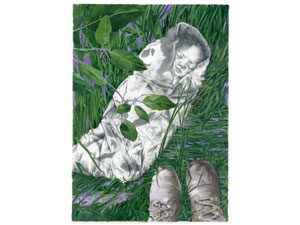
baby roseann illsutrationLisa Adams for Reader’s Digest
At the end of a long day of squirrel hunting not far from his home in Richmond, Indiana, 14-year-old David Hickman sat at 
the side of a country road skinning his prizes with his grandfather. His head was filled with the sounds of the woods: the rustle of September leaves, the crashing of birds through the branches.
Then he heard an odd cooing that sent a chill down his spine. “Did you hear that?” he asked his grandfather Clay Smith.
“I think it’s probably an animal,” Clay replied.
David had been listening to animals all day. This was different. He stood up. “I want to see what it is.”
David followed the sound along 
60 or 70 yards of fence that separated the country road from the forest. The cooing seemed to be coming from the woods. He swung his leg up and over a fence post, avoiding the barbed wire that jutted from the top, and looked down. There was a baby.
Overgrown weeds and brush formed a matted jungle three feet deep, and lying in a tangle of weeds was a tiny, dark-haired baby girl, loosely swaddled in a wet white towel. David jumped down. “There’s a baby here!” he yelled to his grandfather.
At David’s shouts, Clay came running. “Don’t touch,” he cautioned the boy. “Let me see.” Clay peered down at the newborn. The towel had come partly open, and he could see a piece of umbilical cord still attached to her belly. Blood from cuts on her left arm and torso—from the barbed wire, perhaps, or tree branches—had stained the towel red in spots. David knew next to nothing about babies, but to his eye, this one looked impossibly tiny and frail. Her lips were blue, but she was alive.
“We better not touch her,” David’s grandfather repeated. “We might do more harm than good. We’ve got to get her help right now.” Reluctantly, they left the baby in the grass and sped to a nearby farmhouse to call the police. Soon, a deputy sheriff whisked the baby to Richmond’s Reid Memorial Hospital.
That night at the hospital, David 
described to the police over and over the sound he had heard and the shocking sight of a baby in the grass. He overheard the officers discuss the wet towel—a clue, they thought, that the baby had weathered an early-morning rainstorm that had pushed temperatures into the 50s. No wonder she had been so frail and cold, David thought.
David and his grandfather knew the baby had been suffering when they found her, but in the following days, neither the sheriff nor the hospital would tell them anything new. They did learn, however, that social workers had named the baby Roseann Wayne—Rose for Richmond’s nickname, the Rose City, and Wayne for the county name.
A few months later, David was called to the principal’s office at the junior high school, where he was surprised to meet two nurses. One of them held out a baby wrapped in a blanket. “Dave,” one said, “we brought her to you to say goodbye. She’s being adopted.” Eagerly, he held Roseann for the first time, admiring how healthy she looked compared with the pale infant who’d clung to life in the forest.
The year was 1955.
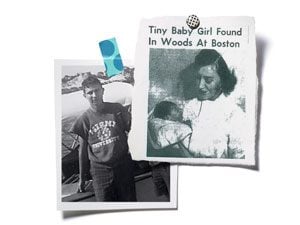
baby roseann newspaperCourtesy David Hickman, Courtesy Josh Smith/Palladium-Item
Over the years, David’s grandpa Clay had tried to track down Roseann’s whereabouts, but he couldn’t get past 
Indiana’s sealed adoption records.
For his part, David tried to put Roseann out of his mind and move on. After graduating from high school in Richmond, David served three years in the Army, then joined his parents and grandparents in Florida, where they’d moved. He got a job building houses and designing air-conditioning systems. In 1966, he married his wife, Gaile, and soon they were raising two sons. 
David and Gaile moved to Vonore, Tennessee, in 2006.
As full as David’s life was, the memory of the blue-lipped baby in the woods often surfaced in his mind. “It hurt me to realize that somebody put her out there to die,” says David. Even though he didn’t expect he’d ever see Roseann again, he couldn’t help wondering if she was healthy and happy.
Gaile understood that he fretted about Roseann as if she were his own flesh and blood. Sometimes she would catch him on their back porch, staring off into the distance. “I would see the ache in his eyes,” she says. “He’s never stopped thinking about the baby he found.”
On yearly fishing trips back to Richmond, David made the rounds from the sheriff’s office to the hospital to the newspaper, but he never heard anything new. Besides a few old newspaper clippings, “it was as if she never existed,” David says.
As a child, Ellen loved her adoptive parents, Merwin and Marga Test, but she hated the scars that roped down her left side, from face to arm to torso. “Where did these come from?” she’d ask her mother. “Sometimes when you adopt children, they have scars,” was all her mother would say.
When Ellen asked where she had come from and who her birth parents were, her parents seemed to dance around the questions. Ellen knew they were hiding something.
Still, the Tests assured Ellen that being adopted meant she was chosen, a special kid; the swimming lessons, ballet classes, birthday parties, and camping trips they lavished on her proved the point. Her family moved from Maryland to a small town in California the summer Ellen was nine, and in time her parents even bought her a horse to ride.
In 1982, at 27 and with two small kids of her own, Ellen decided to pursue the puzzle of her mysterious beginnings. According to her birth certificate, she’d been born in Richmond, Indiana, where her adoptive grandparents and cousins still lived. If any dark secrets were buried, she suspected, Richmond was where she would dig them up. So that summer, she flew to Richmond from California to start her search.
At the Wayne County Courthouse, a clerk 
produced a thick file: 
Ellen’s adoption records. Then, thinking twice, the clerk said, “You can’t see it. Indiana has a closed-records law.” Fighting the temptation to snatch the file from the clerk’s hands and run, Ellen marched across the street to the library, where she dug up reels of newspaper microfiche from September 1955, her birth month. She hoped to find a hospital birth announcement. But within 15 minutes, she was staring at a front-page headline: “Tiny Baby Girl Found in Woods at Boston.”
On September 22, 1955, the story said, a 14-year-old boy named 
David Hickman had heard a strange noise that turned out to be that of a 
newborn infant. Below the headline was a black-and-white photo of a nurse cradling a dark-haired baby. Wow, that’s really sad, Ellen thought. Then: Wait a minute. That could be me.
That night, Ellen tracked down a phone number for Corky Cordell, the town sheriff mentioned in the 
article. “Mr. Cordell,” she said, “do you remember a baby girl found in the woods 27 years ago?”
“Yes!” he blurted. “You live in California, and you have two children!”
Ellen was astounded. “How do you know that?” she stammered.
“I’ve been following you all your life,” he declared. Cordell explained that the sheriff’s department never identified her biological parents. A caseworker had placed her with a couple who had local ties but lived in Maryland—the Tests, Ellen’s adoptive parents. The Tests’ annual Christmas card to the local adoption caseworker kept Cordell apprised of Ellen’s life over the years.
Cordell also told her that her name hadn’t always been Ellen. For three months, she’d been Roseann Wayne.
The truth about her identity left 
Ellen shell-shocked. Back in California, her father, at last resigned to talking about Ellen’s history, explained that he and his wife had thought the truth was “too horrific.” Maybe they were right, Ellen thought. It sickened her to think that anybody could abandon a baby in the woods.
Before leaving Richmond, Ellen had found an address for the only David Hickman listed in the local phone book. She had questions, yes, but mostly she wanted to thank him. But the address turned out to be the wrong David Hickman. The David Hickman who’d found her, by then a 41-year-old man, had moved away.
OK, Lord, she thought, if I’m ever supposed to meet him, you’re going to have to arrange it.
In 2013, at 73, David was ready to give up and move on—“I guess I’m not meant to find her,” he’d tell Gaile­—when a mutual acquaintance recommended he get in touch with a retired deputy sheriff named John Catey. “Let’s try this just one more time,” Gaile said to David.
They called. Catey pledged, “I’m going to do everything that I can to 
get you and your baby together by Christmas.” As he talked to more than 80 Richmond old-timers, bits of 
information started to come together. Someone knew that baby Roseann had been renamed Ellen—and that her last name started with T. The adoptive parents had moved to Arizona, or was it California? One day, luck led Catey to the home of Kevin Shendler. There Catey came across an old photo of Kevin’s aunt and uncle—Merwin and Marga Test. Yes, Kevin assured him, the Tests had adopted a baby in 1955.
On December 21, 2013, Ellen’s phone at work rang. “This is Dave Hickman,” a voice said.
“I’ve been wanting to talk to you!” Ellen responded. She rushed to put his mind at ease. “Dave, I’ve had a great life!”
David was at a loss for words. He had dreamed of this moment for 
58 years. Ellen eagerly told him that she was happily married with two grown children and four beautiful grandchildren. Life was good.
Last May, after months of e-mails and weekly phone conversations, 
Ellen and David met face-to-face at the 4th Floor Blues Club in Richmond, Indiana. Together they drove the country road where David and his grandfather had sat skinning squirrels all those years ago. David showed 
Ellen the thicket of grass and branches, on the far side of a five-foot barbed wire fence, where he had discovered an infant: the baby named Roseann, aka Ellen Test. Had he been ten feet to either side of the fence post that he’d jumped, he might have missed seeing her. Someone had most likely lifted her over the fence and dropped her into the brush.
Ellen looked at David. “If it hadn’t been for you, I’d be dead.”
“I was guided there by the grace of God,” David says now. “For 58 years, I worried about this little baby. It’s like a fairy tale with a very bad beginning and a wonderful end.”

Source: rd.com

Wednesday, October 1, 2014

Love That Last's Forever

“Relationships are never easy. Some days you’re going to wake up and that love you know you have for the person in the bed next to you, isn’t going to come so naturally. We always say “no one told us it was going to be this hard” but they do.We choose not to listen, because it seems so unreasonable that one day you will be able to keep your hands off of each other. One day you will spend your free time away from each other. The only way you can make a relationship last is if you work at it every day and never give up on it. Because if you take time to fight and argue and still can’t imagine leaving them, then you love them. And that’s the kind of love that’s forever.”~Unknown

This Is What True Love Is All About

A Good Relationship is when two people accept each other’s past, support each other’s present, and love each other enough to encourage each other’s future. So don’t rush love. Find a partner who encourages you to grow, who won’t cling to you, who will let you go out into the world and trust that you will come back. This is what true love is all about.

Source:  lessonslearnedinlife.com

October

Thirty days hath September,
April, June, and November;
February has twenty-eight alone,
All the rest have thirty-one,
Excepting leap year, that's the time
When February's days are twenty-nine.